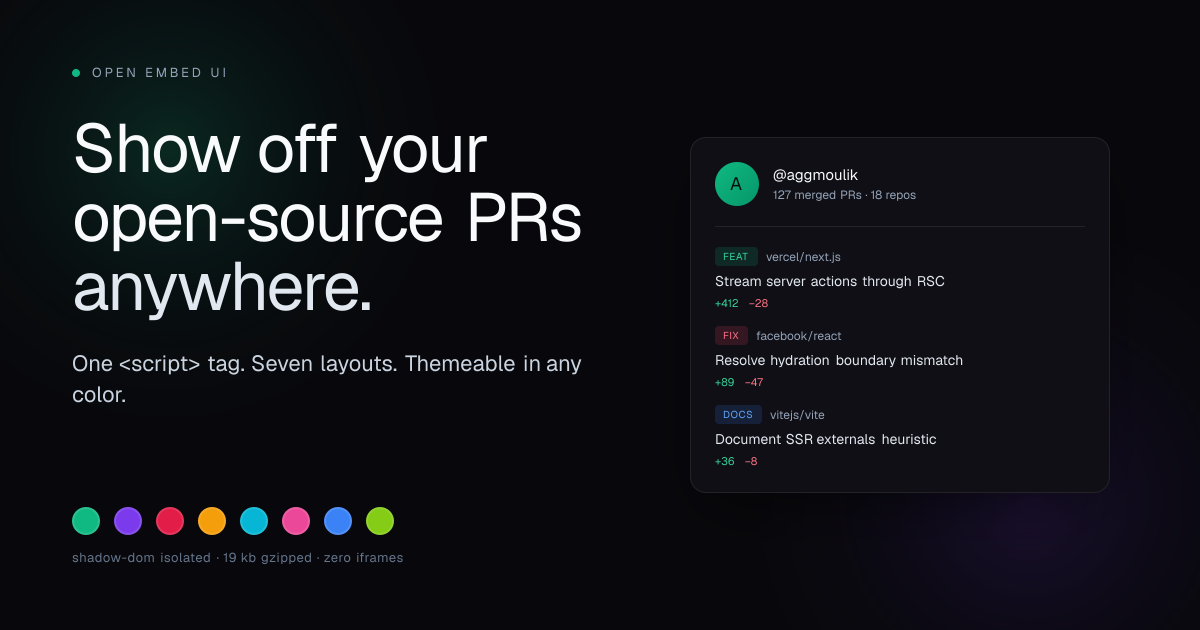
The Open Source Contributions card on the front page of this site is one <script> tag. That’s the project.
I wanted to show my merged PRs on this portfolio without redeploying every time something landed, without iframes carrying their own chrome, and without an OAuth dance just to render a card. Seven weeks of evenings later I had a hosted dashboard, a Cloudflare Worker embed API, a Preact + Shadow DOM widget under 18 KB gzipped, and a backlog of bugs I’d never have predicted from the top.
v1 was an iframe, and v1 was wrong
The first version of this widget was a Next.js iframe. It worked. It was also bad: every embed loaded a full HTML page, dragged in its own Tailwind, and forced fixed width/height that broke any host trying to do dynamic layout. Themes required a reload. Hydration was its own circle of hell.
I ripped it out on day two and rebuilt the embed as a Shadow DOM + Preact custom element bundled to a single IIFE. The first stable build came in at 9.6 KB gzipped including Preact. Every other decision in this project descends from that one.
Preact, and the receipts
The widget loads on every page view of every site that embeds it. React 19 was a non-starter the moment I measured:
| React 19 | Preact | |
|---|---|---|
| Runtime size (gzipped) | ~45 KB | ~3 KB |
| Total widget bundle | ~55 KB | ~10 KB |
| API surface | — | ~99% React-compatible |
| JSX attribute | className | class (native HTML) |
The numbers ended the debate. But the cost of choosing Preact isn’t free, and the cost shows up at boundaries you don’t see in a benchmark:
What hurt:
classvsclassNamein JSX. Trivial in isolation. Annoying when you’re context-switching between dashboard React code and widget Preact code inside the same monorepo, twenty times an hour.- shadcn doesn’t work in Preact. The dashboard is shadcn-on-radix; the widget can’t share a single component with it. The preview app in the monorepo had to keep its own hand-written Tailwind
@applystyles for the same primitives. Two sources of truth for “what does a button look like in this brand,” forever. - Strict Mode double-mounts. The dashboard runs React 19 in Strict Mode. When the widget’s preview component mounted twice,
attachShadowthrew because the host element already had a shadow root. One-line fix — recreate the host div on each mount, clean it up on unmount — but the failure mode is silent in dev and loud in user reports. - The preview modal had to be a parallel React implementation. Hydration mismatches made it impossible to use the actual Preact widget inside the dashboard’s React tree. There’s now a second
WidgetRendererin pure React that mirrors the layouts — duplicated rendering code, kept in lockstep by hand. The maintenance tax is real.
What I’d still do again: all of it. Carrying a parallel React renderer for the dashboard preview is a fraction of the cost of asking visitors to your site to download 55 KB of someone else’s framework before they see your face.
Shadow DOM is the easy part, until it isn’t
Three bugs that ate days I’ll never get back:
Terser mangled the global. The IIFE bundle exposed GitHubEmbedWidget as a named global. Default terser config minified it to var t = function() {…}. The embed script wasn’t found, the widget never mounted, and nothing showed up in the console. Fix:
terser({ mangle: { reserved: ['GitHubEmbedWidget'] } })next/script and SSR. Mounting the widget loader via next/script in the dashboard’s preview surface threw a hydration error every reload — the server rendered no script tag, the client added one, React panicked. The fix is the kind of code you don’t put in a portfolio article: drop next/script entirely, manually document.createElement('script') inside a useEffect. Inelegant. Works.
Shadow DOM doesn’t inherit host Tailwind. I’d been writing layouts with className="bg-card text-foreground …". Inside a Shadow DOM, the host page’s Tailwind stylesheet doesn’t apply — none of the classes rendered. The fix isn’t “ship Tailwind inside the widget” (the JIT can’t see inside a JS string, and shipping preflight is wasteful). The fix is @apply inside a single widget.css processed at build time and injected into the shadow root as a string. Utility-first authoring, classical CSS shipping.
Theming was harder than it looked
The theming layer — five preset palettes (emerald, violet, rose, neutral, mono) plus per-token OKLCH overrides for background, foreground, card, border, brand, and muted — looked like a CSS-variables Tuesday. It took a week and three subtle bugs to land cleanly.
- Tailwind v4’s
@theme inlinedoesn’t preserve your aliases. The dashboard preview uses utility classes, which v4 resolves to the un-prefixed source variable at build time. My runtime’s--color-*overrides were getting bypassed. Fix: emit both prefixed and unprefixed values as inline styles on the preview wrapper. - Legacy widgets had sparse overrides. Owners who’d configured a single color before themes existed rendered as “default green plus their one override” — visually broken. The fix wasn’t a client refactor — it was server-side normalization in
getEmbedPayload, merging preset + sparse overrides into a complete token map at the API boundary. Old data renders correctly without anyone re-saving anything. - The mount-order race. The widget’s
<style data-geu-theme>injection effect depended on[data]. But the<div ref={rootRef}>only mounts oncedataANDresolvedLayoutare both set. By the time the ref attached, the effect was done firing. Took an embarrassing amount of staring at the screen to spot. One-character fix.
When owners try to hide your branding
The widget renders a “powered by openembed/ui” footer at the bottom of every embed. About a week after shipping the theme picker, I realized owners with full per-token control could set the footer’s foreground to --color-background and make it disappear. The footer is the project’s distribution surface. It can’t be defeatable.
So the watermark now ignores user theming entirely:
- Full-width white card, regardless of host theme
- Hardcoded colors — no CSS variables touch it
!importantondisplay,color, andvisibility- Real landing logo (the
⌥glyph in a black rounded square + theopenembed/uimono wordmark) instead of inline text
It’s the only place in the widget that defies the user’s choices. Worth it.
Stack
- Dashboard — Next.js (App Router, React 19), Tailwind v4, shadcn/ui, better-auth (GitHub OAuth), deployed on Vercel
- Widget — Preact + hooks, Shadow DOM, Vite IIFE bundle,
@apply’d Tailwind injected as a CSS string - API — Cloudflare Worker, per-widget origin allowlist checked on every request, hashed-IP rate limiting on the waitlist
- Data — Drizzle ORM over Turso (libSQL/HTTP — no long-lived connections)
- Monorepo — pnpm + Turborepo, with strict package boundaries so the widget never accidentally pulls in dashboard code
What’s left
The hosted version on open-embed-ui.vercel.app works today. The repo is MIT and accepts PRs. I’m still chipping at bundle size (current build: 18.01 KB against a 25 KB CI budget), onboarding polish, and a couple of layouts that need a designer’s eye more than a programmer’s. The project documents its own decisions in docs/features/NN-…/ and dated session logs, which has saved me from re-deriving the same Tailwind v4 trap twice.