Introduction
Strapi’s REST API is convenient — until your home page starts dragging because every fold pulls in five components’ worth of data when you only render one of them. This post is about a small but high-leverage technique — populate.on — that lets you fetch only the components a page actually needs, plus the broader plan I put around it: APM, Redis caching, and a longer-term move to GraphQL.
Problem Statement
Strapi’s REST endpoints, called with default population behaviour, return the entire dynamic-zone payload even when the page rendered a single component. A page with five components in the same dynamic zone ships data for all five — even when only one is rendered.
This doesn’t matter at small scale. It matters a lot once:
- Each component grows to include media, tables, FAQ blocks, and nested relations
- The frontend is bandwidth-constrained on mobile
- Strapi’s response time creeps up because of the deep populate cost
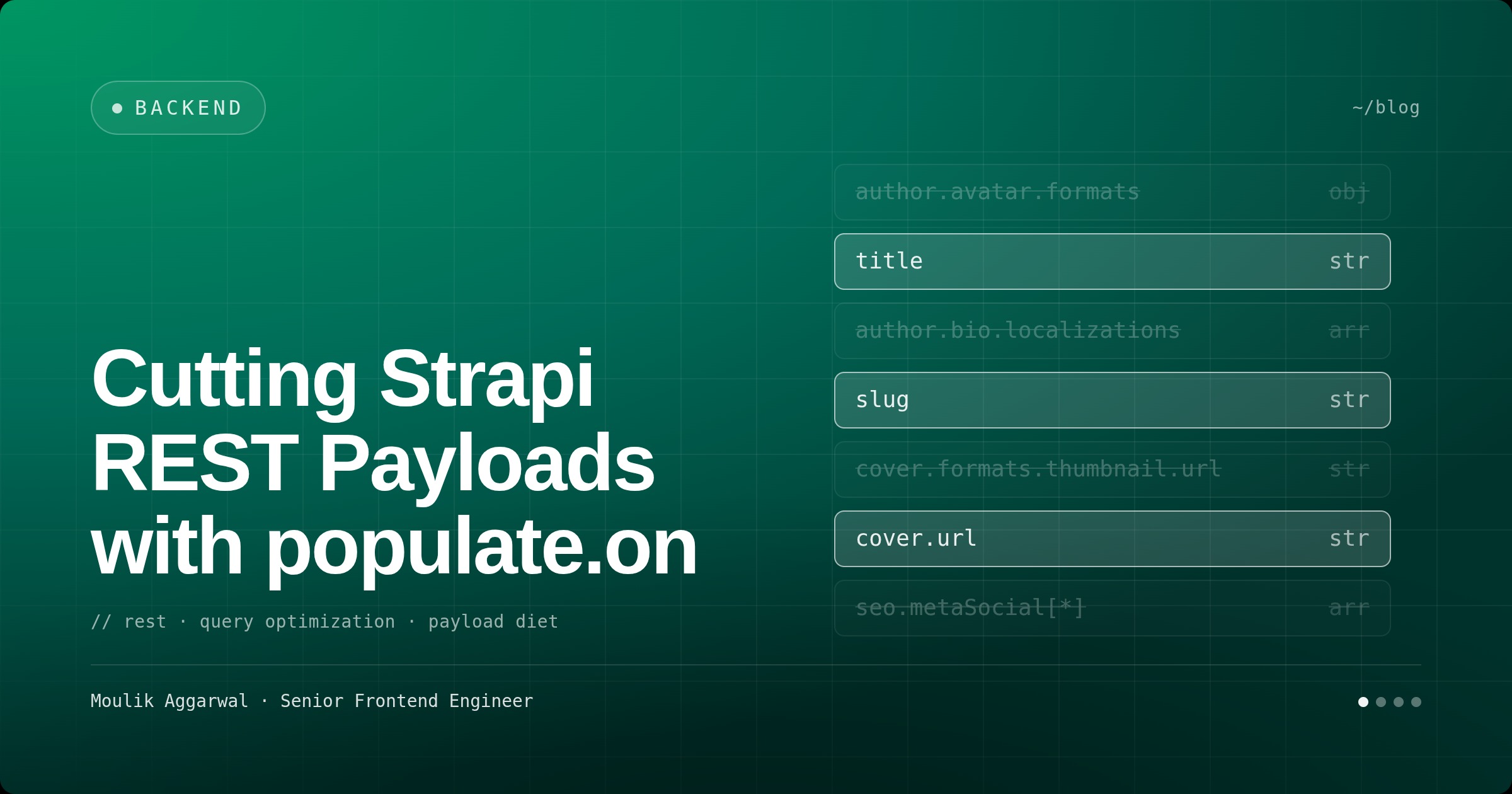
The fix is scoped population — telling Strapi exactly which component(s) you want and how deep to go.
The populate.on Technique
Strapi’s populate.on operator lets you target individual components inside a dynamic zone and define a populate strategy per component. Example — fetching only the testimonial component from a top-fold dynamic zone with multiple sibling components:
const homePageTopFold = await fetchAPI('/inner-pages-data', {
  filters: {
    url: '/home-top-fold',
  },
  populate: {
    pageData: {
      on: {
        'shared.testimonial-component': {
          populate: {
            testimonials: {
              populate: '*',
            },
            headerContent: {
              populate: '*',
            },
          },
        },
      },
    },
  },
});
Two things to notice:
- Component-scoped key:
'shared.testimonial-component'matches the component UID. Anything not listed underonis excluded from the response — sibling components in the same dynamic zone don’t ship. - Per-component depth: inside the chosen component, you can still recursively populate (
testimonials.populate: '*'). You’re not stuck choosing between “everything” and “shallow.”
For pages that pull more than one component, on accepts multiple component keys side by side.
Reference: Strapi v4 — Understanding
populate
Why Query Improvements Aren’t Enough
Tightening populate reduces payload size, but it doesn’t reduce the number of times Strapi has to compute that payload. Even with scoped populates, repeated requests still arrive for the same content fragments — top-fold blocks, navigation config, footer config — none of which change minute-to-minute.
The pieces I put around the query optimisation:
1. APM Integration
Strapi typically ships without first-party instrumentation. No p95 response times, no slow-query log, no alerting. The fix:
- Run Strapi as a fully-instrumented Node app under your APM of choice
- Treat it like any other backend service: track route p95s, error rates, and resource use
- Catch slow endpoints before users do, especially during traffic spikes
2. Redis Caching for Database Queries
Most CMS reads are read-heavy and tolerate seconds-to-minutes of staleness. That’s a textbook fit for a Redis cache layer in front of expensive Strapi queries.
The load-test results were stronger than expected — ~5× throughput, average response times down by up to 95%, and >50% reduction in pod and memory usage under load. The full breakdown, with numbers and the release plan, is in Adding Redis Caching to Strapi — 5× Throughput on Production.
Metrics worth watching once it’s in:
| Metric | What it tells you |
|---|---|
| Hit/miss ratio | A high hit ratio means caching is doing its job. A low ratio means your keys or TTLs need rework. |
| Average response time | Should fall on cached endpoints; flat lines mean the cache isn’t being read. |
| Eviction rate | High eviction = cache is too small or TTLs are too aggressive. |
| Invalidation frequency | If you’re invalidating constantly, you’ve cached the wrong layer. |
The trap with CMS caching is invalidation — editors expect changes to go live “now.” Tag-based invalidation tied to Strapi’s lifecycle hooks is the cleaner approach.
Should We Move to GraphQL?
Once you’ve fought populate enough times, the GraphQL question comes up.
Where REST hurts
REST endpoints encode their shape on the server. Two failure modes:
- Over-fetching: ask for a user, get profile + posts + comments + likes. If you only need name and email, you’ve shipped the rest.
- Under-fetching: need user + last three posts → two requests, possibly a waterfall.
populate.on mitigates over-fetching, but the contract is still “the server decides the shape, the client adapts.”
Where GraphQL helps
GraphQL flips it: clients describe the shape, the server resolves it.
- One request, exactly the fields you want
- No payload waste
- Schema is self-documenting and typed end-to-end
Where REST still wins
REST remains the right call when:
- Endpoints are simple and stable
- You need cacheability at the HTTP layer
- The team is more comfortable with REST conventions
My recommendation
Adopt GraphQL for read paths where component composition is highly variable (CMS-driven pages, list/detail surfaces with optional sections). Keep REST for stable, well-understood single-resource endpoints. The migration doesn’t have to be all-or-nothing — Strapi exposes both, and you can run them side by side per surface.
Key Takeaways
populate.onis the cheapest performance win in Strapi REST. If your dynamic zones return everything by default, you’re shipping payload nobody renders.- Query tuning ≠ infrastructure. Pair it with APM and a cache layer or you’ll plateau.
- Pick cache invalidation deliberately. Lifecycle-hook-driven, tag-based invalidation beats time-based TTLs for editorial content.
- GraphQL solves over-fetching by design, not by discipline. Use it where shapes are variable; keep REST where they aren’t.
- Measure or stop guessing. APM on Strapi turns “the CMS feels slow” into actionable p95 numbers.
Conclusion
populate.on is a tiny piece of the Strapi REST API, but it changes the default from “give me everything” to “give me exactly this.” That single shift, applied across high-traffic CMS-driven surfaces, is a meaningful payload win.
Past that, the playbook is the same as any backend service: instrument it, cache the hot paths, and pick your transport (REST vs GraphQL) per surface based on how variable the shape is. Strapi gets faster the more you treat it like a backend, not just a CMS.